Voltverashop Was Losing Buyers at the Moment They Needed to Trust It

Rebuilt the e-commerce experience for a D2C brand competing against Amazon so buyers could confidently spend ₹40,000 with a brand they'd just discovered.

Solo Product Designer · D2C E-commerce · 3 Weeks · In Development

Impact: 15+ screens · 10+ edge cases · WCAG 2.1 AA · Client-approved for development · Design system and handoff complete

View Prototype

Why the Product Exists

Problem
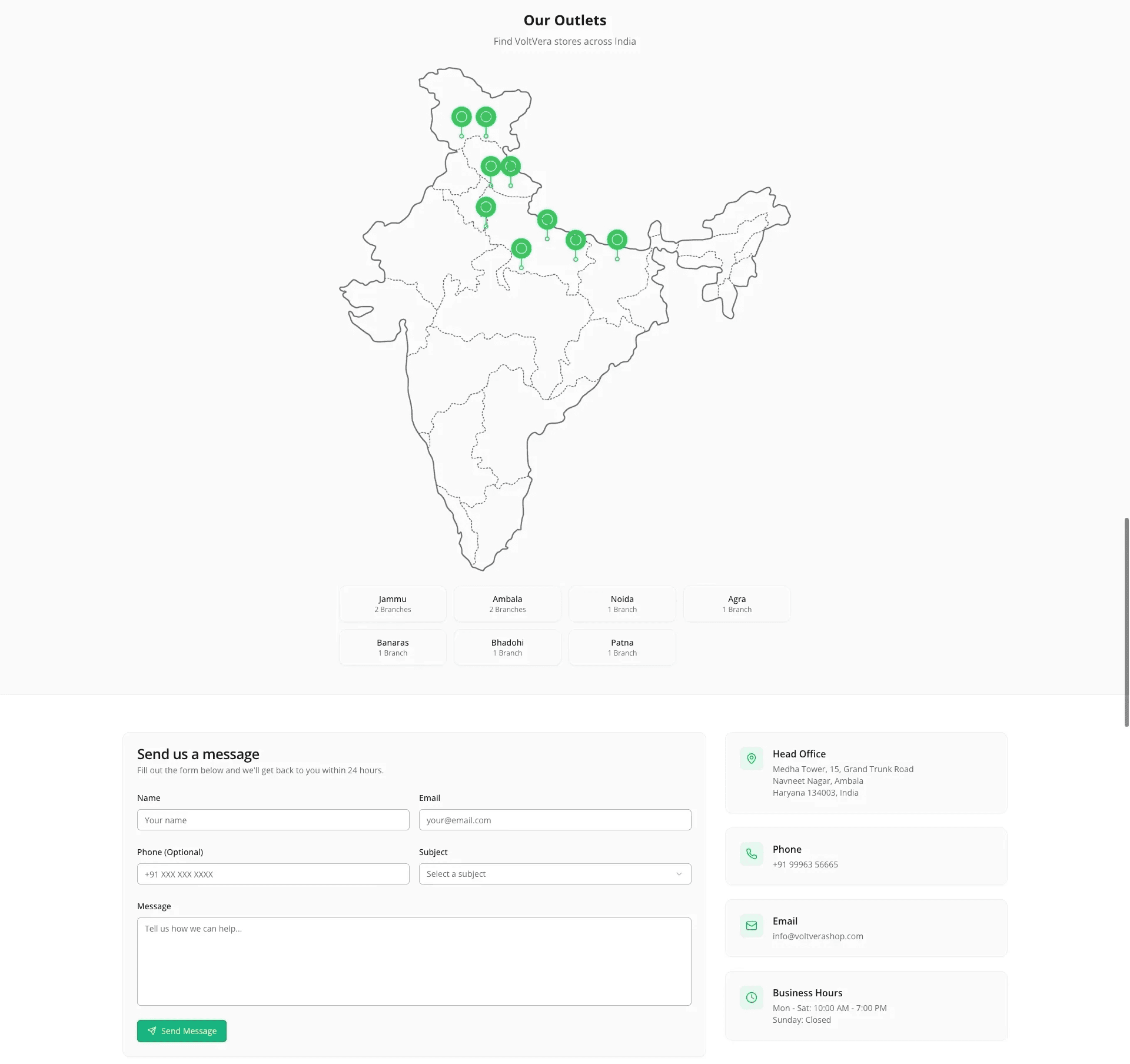
Voltverashop sells alkaline purifiers, BLDC fans, Smart TVs, and EV scooters across 9 stores and a 24-hour delivery network in India. Products go up to ₹63,750. The website had 6 trust-critical failures, broken category filters, three different store counts across three pages, and no warranty or installation info visible on the pages that needed it most. Buyers were hitting the moment of decision and finding nothing to hold on to.

Business relevance
High-consideration purchases don't convert on curiosity. When buyers couldn't find answers, they left to Google — which sent them to Atomberg, Livpure, and Amazon. A strong product, real stores, and 24-hour delivery were invisible behind a homepage that couldn't communicate any of it. Every unanswered question was a lead handed to a competitor.

Why now
The infrastructure was there. 9 stores. Dark store delivery. A cross-category product range no competitor matched. The website hadn't kept up.

Without fixing the trust gap, the brand's real advantages didn't exist for anyone discovering it online.

What I Owned

Solo end-to-end · heuristic audit to dev handoff · 3 weeks

  • Heuristic evaluation across Nielsen's 10 principles, 6 priority failures identified

  • Competitive analysis: Atomberg, Livpure, Ather Energy, Amazon India, Blinkit

  • Full IA and sitemap before touching a single screen

  • Design system: color tokens (all WCAG tested), typography, components

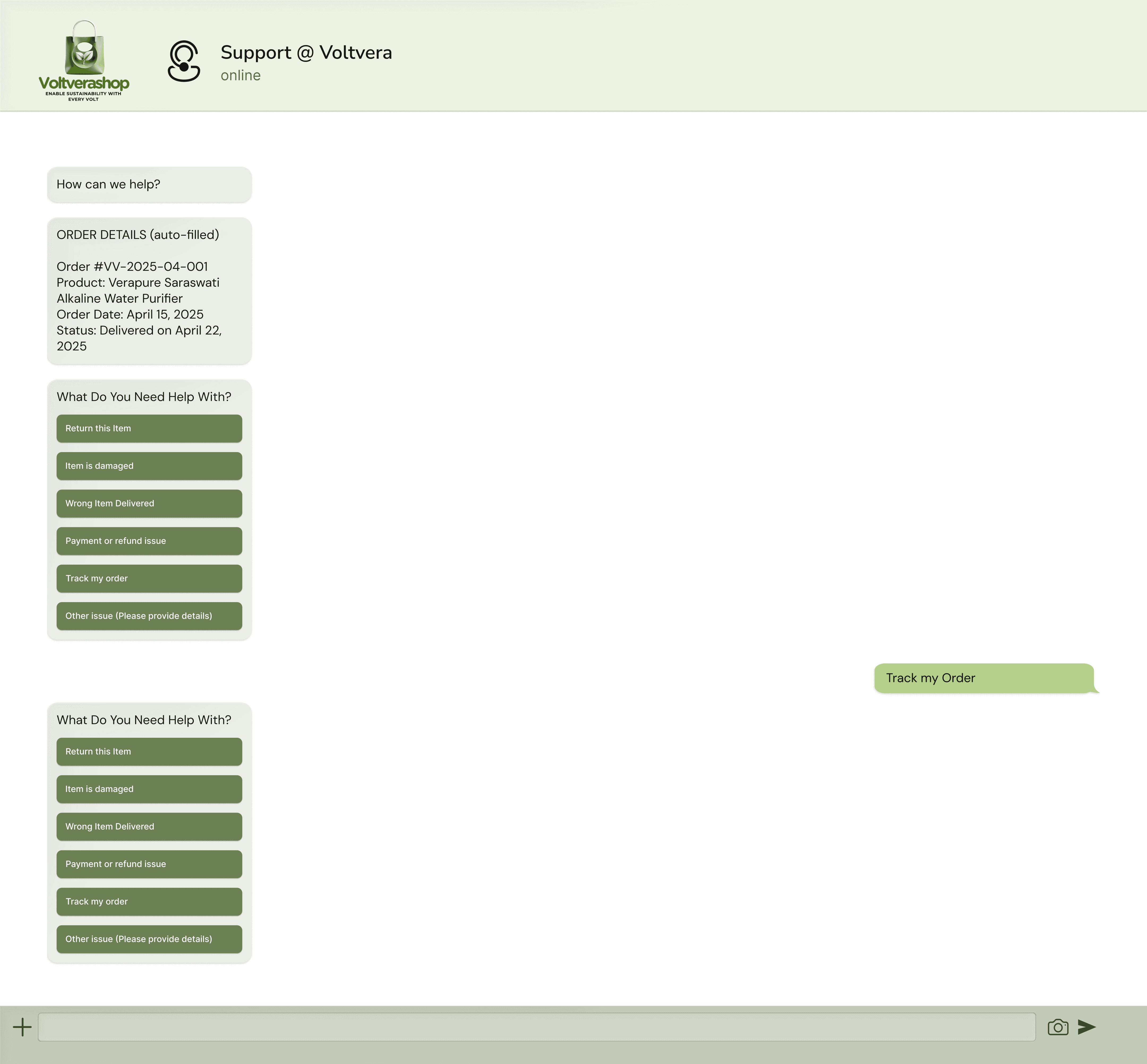
  • 15+ screens across Homepage, Product Listing, PDP, Cart, Checkout, Order Management, About, Support

  • 10+ edge cases: out of stock, payment failed, all order states, empty cart

  • WCAG 2.1 AA audit, 100% pass across every screen

  • 24,000-word dev handoff + 12-week roadmap + GA4 event spec

Voltverashop (D2C E-commerce) · Full Website Redesign

This wasn't a visual refresh. It was rebuilding the system that was losing buyers before they could decide.

WHERE BUYERS WERE LEAVING

What Was Costing CodSphere Leads

“You're asking me to spend ₹40,000 with a brand I've never heard of and I can't find the warranty anywhere."”

Prospective Buyer (unprompted feedback)

The problem wasn't one thing. It was a pattern of signals that said nobody was paying attention.

Previous Website (Before)

What was breaking


  • Category cards: icon only, no photo, no price range

  • "Sign Up" as the primary CTA before any product was seen

  • No warranty or delivery info on purifier and fan pages

  • Franchise pitch and broken gallery sitting mid-homepage

What it caused


  • High-consideration products had the least purchase support

  • Buyers had no reason to choose Voltverashop over Amazon

  • Mixed audience signals confused the consumer journey

  • Any buyer who checked twice caught a different store count

From this, I identified three structural priorities: compress competing signals, surface proof earlier, and create a single clear conversion path.

Conversion Architecture Realignment

The redesign structured a clear path from understanding → trust → action, with the homepage anchoring the journey and keeping trust signals visible even when users skip steps.

Primary Conversion Flow

Homepage → Clarify value (Value Proposition)
Success Stories → Evaluate proof
Testimonials → Reinforce trust
Start Free Trial → Take action

This sequence ensures users encounter credibility signals before being asked to act, improving confidence at the point of conversion.

Updated Homepage

Hero section (Clarified positioning)

Reworked the landing to clearly communicate what CodSphere does, replacing competing messages with a single, focused value proposition.

Case studies & testimonials (Proof surfaced earlier)

Introduced success signals earlier in the experience to build trust before users explore deeper into the product.

Interaction patterns (Jakob’s Law)

Replaced unfamiliar interactions with standard patterns users already recognize, reducing confusion and improving usability.

Page Flow (Defined conversion path)

Reorganized the homepage into a clear sequence from value proposition → proof → action, reducing competing paths and making the trial entry consistently visible.

Post-launch: increased inbound interest and client-initiated conversations about the website during sales calls without any additional outreach.

Surfacing Proof Earlier (Success Stories)

This strengthened credibility before users reached conversion points.

Success Stories UI

Introduced as a dedicated proof layer, allowing users to evaluate real outcomes earlier in the journey.

Capturing Intent with Confidence (Start Free Trial)

Designed the trial page as a focused conversion surface with minimal friction and clear next steps.

Start Free Trial UI

Designed as a focused conversion surface with minimal friction, reinforcing trust through embedded testimonials.

Impact & Learnings

Impact

  • Increased inbound interest and client-initiated conversations

  • Improved visibility through clearer positioning and SEO alignment

  • ~70% of visitors progressed toward trial or inquiry (per CEO post-launch review)

  • Reduced dependence on sales to explain product value

Trade-offs

  • Clarity over completeness: One entry point, faster first impression

  • Guided path over open exploration: Less freedom, better conversion

  • Trust before features: Credibility closes faster than specs on B2B

  • Redundant trust signals: Because users don't follow ideal flows

Learnings

  • Early proof significantly reduces hesitation in B2B decision-making

  • Conversion improves when trust signals are not dependent on strict flow

  • Structural clarity has more impact than visual redesign in early-stage funnels

Explore More Projects

Connect to Content

Add layers or components to swipe between.